
WireGuard encrypts the contents of a connection, but its traffic still has recognizable patterns. A network using deep packet inspection (DPI) can filter those patterns, so an otherwise valid VPN configuration may stop connecting. WireSock Secure Connect gives Windows users ways to change how that traffic looks on the wire.
There are two practical starting points: send extra junk packets before the handshake while keeping a standard WireGuard server, or use AmneziaWG with a server configured for the same protocol. Below, I’ll show the junk-packet settings, explain when a matching AmneziaWG setup is needed, and look at the implementation details behind those choices.
First, try junk packets with a standard server
If you already have a working standard WireGuard profile, junk packets are a smaller experiment than replacing the server protocol. They leave the real WireGuard messages unchanged. A compatible client sends additional UDP datagrams that the server can discard before processing the actual handshake.
In WireSock, add the following to the existing [Interface] section of that standard profile. This is a starting example, not a complete connection profile:
Jc = 3
Jmin = 50
Jmax = 1000
Jd = 0
Here Jc is the packet count, Jmin/Jmax bound the sizes in bytes, and Jd is the delay between packets in milliseconds. Do not add AmneziaWG header or padding parameters to a standard WireGuard profile: those require a compatible server. See WireSock’s parameter reference for the GUI and profile controls.
Check the application’s global overrides as well as the profile. With profile settings in effect, Jc = 0 or an omitted Jc disables junk traffic; a global override can change that behavior. If using WireSock’s QUIC protocol masking, set Jc = 0 as its documentation directs. More noise is not necessarily a better imitation.
The limitation is straightforward: the real handshake and data packets are still recognizable WireGuard. This experiment may change the outcome for a particular filter, but it does not solve endpoint blocking, a blanket UDP restriction or every form of stateful DPI. Compare it with the same known-good profile and endpoint, and check that application traffic works after the handshake. Extra packets also add traffic and may add connection delay.
A historical WARP example
A Rostelecom example illustrates the idea: junk packets allowed a WireGuard-based Cloudflare WARP profile to connect where its ordinary handshake had been blocked. That was a result on a particular network at the time, not evidence of a universal Rostelecom policy or a bypass that will keep working indefinitely.
wgcf is an unofficial tool for generating WARP WireGuard profiles. That is different from configuring the current Cloudflare One Client: Cloudflare documents WireGuard and MASQUE tunnel protocols, with MASQUE as its default. The WireGuard junk-packet example does not apply to a MASQUE tunnel, and it does not establish that wgcf enrollment or service access still works for a particular account.
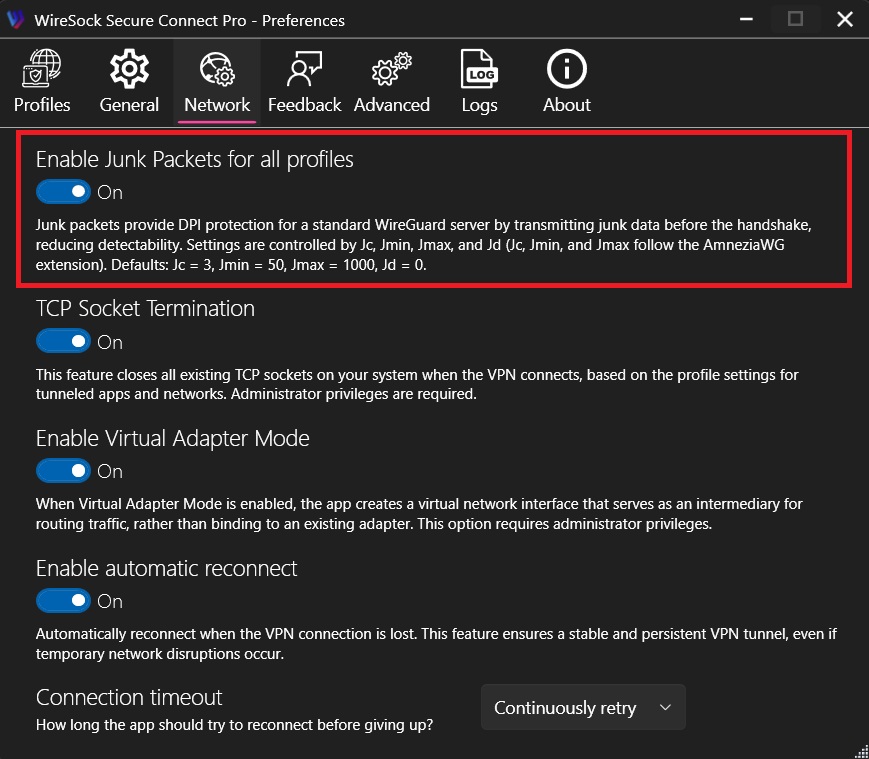
The screenshot above shows the interface used in that setup. For a current installation, use the controls and compatibility guidance for the WireSock version you have installed.
When you control the server: AmneziaWG
AmneziaWG changes the wire appearance of WireGuard traffic to make familiar signatures less useful to DPI systems. The implementation I first integrated into WireSock used three main techniques:
- Send extra, random-looking UDP datagrams before the handshake. These are separate packets, not additions to the encrypted payload.
- Replace the recognizable packet-type values with configured values.
- Add random padding around handshake messages to change their visible lengths.
These techniques have different compatibility requirements. Extra junk datagrams can be sent before an otherwise standard WireGuard handshake without changing that handshake. Changing message types or framing requires a compatible receiver and matching settings at both ends. The client and server must agree on the message format and its parameters.
AmneziaWG has continued to evolve. Its upstream documentation now describes generation 3.1, including header protection and additional padding behavior. WireSock’s profile documentation explicitly lists standard WireGuard and AmneziaWG 2.0. Treat those as distinct compatibility targets: a newer server or profile is not automatically usable by every client with “AmneziaWG support.” Check the client release, server mode and supported parameters together.
Choosing a compatible server setup
A self-hosted server gives you control over the endpoint and obfuscation settings. It does not make the connection invisible: a network can still block the server address, restrict UDP, or classify traffic by behavior rather than a single handshake signature.
For a self-hosted setup, use AmneziaWG Server Tools. In the linked source revision, fresh installations default to AWG 2.0. AWG 3.1 is an explicit option, and an experimental BoringTun userspace backend is available alongside the default kernel backend. Existing installations retain their selected protocol mode.
Choose the protocol mode for the client you actually intend to use. For WireSock, start with the documented AWG 2.0 compatibility rather than enabling the newest server mode by default. The optional web panel and obfuscation proxy are separate components; neither is required just to run an AWG server.
Before installing, take a server snapshot, arrange a recovery path and read the project’s requirements and installer at a chosen source revision. The installer runs with root privileges and changes packages, networking and services. Follow the project’s maintained installation instructions for your chosen backend. Import the generated client profile without mixing padding or header values from a different server.
Under the hood: WireSock and obfuscation
The WireGuard encryption runs in user mode; packet interception and injection rely on the WinpkFilter kernel driver. In transparent mode, WireSock can select traffic without adding a virtual network adapter or changing the system routing table. Virtual adapter mode does create an interface and configure routes. Both modes use WinpkFilter.
That separation is useful for application-specific tunneling and can also allow WireSock to operate over an existing VPN connection. The result still depends on the other VPN’s routing, filtering and access policies. Architecture alone is not a throughput benchmark or a guarantee that two VPN clients will cooperate.
I began exploring this architecture in my earlier work on WireGuard blocking, combining BoringTun with Windows Packet Filter. AmneziaWG support followed in April 2025. The distinction between the encryption engine and packet interception is useful when considering where obfuscation belongs.
I still prefer keeping obfuscation separate from the cryptographic implementation where the protocol allows it. A small outer layer is easier to experiment with than a collection of patches to several WireGuard engines. The important detail is which bytes each layer processes and authenticates.
For a concrete example, the historical BoringTun branch writes the configured handshake type before calculating the message MACs. In the WireGuard message format, MAC1 covers the preceding message bytes, including the type field; MAC2, when a cookie is in use, also covers the preceding bytes. A layer that rewrites that type must also handle the corresponding MACs. This is separate from the Noise handshake transcript hash and from adding an outer prefix that the receiver removes before processing the inner message.
A proxy can therefore help, but it must understand the exact framing it is translating. It is not enough to change a few bytes after encryption and assume that any unmodified implementation, including WireGuardNT, will accept the result.
There is now a practical example of the layered approach in amneziawg-proxy. It changes outer padding for protocol imitation while preserving the inner AmneziaWG message. Its documented scope is AWG 1.0/2.0, not AWG 3.0 or later, where padding participates in header protection. It is an AWG proxy, not a general adapter from standard WireGuard to every AmneziaWG generation.
Choosing what to try
AmneziaWG adds useful options when ordinary WireGuard is filtered, and I appreciate the work that made those options available. The important practical choice is the smallest change that addresses the block you are observing: junk traffic with a standard server, a matching AWG client/server pair, or a coordinated protocol-imitation setup.
Keep those choices distinct, measure them on the network that matters to you, and keep a working baseline for comparison. Obfuscation changes what a filter sees; it does not remove the need for compatible peers or guarantee access.
If you want to discuss the client architecture or share a practical result, join the community: Telegram, Discord or Reddit.